Monday, June 3, 2013

It's Time to Rebuild


Haggai 1:4-7 Is it a time for you yourselves to be living in your paneled houses, while this house remains a ruin?”Now this is what the Lord Almighty says: “Give careful thought to your ways.  You have planted much, but harvested little. You eat, but never have enough. You drink, but never have your fill. You put on clothes, but are not warm. You earn wages, only to put them in a purse with holes in it.” This is what the Lord Almighty says: “Give careful thought to your ways.”

On our college mission trip to Eleuthera in the Bahamas, I learned that the church there struggles with keeping young people connected to the church family in the very same way many UM churches struggle with absent younger generations here in South Carolina. A 29-year-old staff member of Bahamas Methodist Habitat said to me when I asked if he went to church, “No. Not regularly. Church has become like watered down kool aid, and you know everyone hates watered down kool aid.” I agree; who does like watered down kool aid, or Gatorade or lemon or any such beverage? It certainly doesn’t make you want to take another sip. Another person said to me, “It’s like the church started out with a great hamburger piled high with all the toppings, but over time we’ve parsed out the meat, the lettuce, the tomato, the cheese, so all we have is a bun with no substance between. When we bite, it’s empty; it’s all fluff.” I agree; you can’t call a bun a hamburger because without the meat (or blackbean burgers as I eat), or lettuce, tomato, cheese, onions, ketchup or mustard it’s not really a hamburger in the full understanding or expectation of what a hamburger is supposed to be. It’s merely simple carbs, or “fluff” that has no sustaining substance.

These sentiments were shared by many of the young Bahamian 20 somethings—though few gave such colorful illustrations.  “Watered down kool aid” or the hamburger analogy might not be the illustrations I would use to describe the plight of churches today in relationship with younger generations, but they express a sentiment shared by too many people under the age of 30. Statistics prove these feelings are more than just the thoughts of a few. The Pew Research Center says 1 in 5 have absolutely no religious affiliation. Only 1 in 5 people under the age of 30 attend church regularly (and the poll’s “regularly” is once a month). 3 out of 5 people disconnect from the church after age 15. 47% of people don’t believe that God exists. Such statistics along with conversations I’ve had not only with Bahamian once-upon-a-time church goers under 30, but conversations I’ve had with people right here in Columbia worry me not only about the future of our church, but worry me that we are not doing a good job of being Christ to the world. Every time we celebrate communion, as my church did this past first Sunday of the month, don’t we say, “Make [the gifts of bread and wine] be for us the body and blood of Christ, that we may be for the world the body of Christ, redeemed by his blood,” or “By your Spirit make us one with Christ, one with each other, and one in ministry to all the world”? I’m reading The Daniel Fast by Susan Gregory, and she writes very early in the book, “As pressures of the present-day world increase, today’s followers of Jesus Christ are seeking a deeper, more meaningful relationship with their Lord. They want a faith that goes beyond Sundaymorning. They want their faith to make a difference in their families, their jobs, their everyday surroundings.” In other words, we’re called as people of God to be more than “Sunday Christians” or what John Wesley called “Almost Christians” and even “Honest Heathens.”

Our mission is not to merely get “butts in pews,” as a former leader in my own congregation once said to me. Our mission asGod’s holy church—Christ’s body—is to make disciples for the transformation of the world, or as Susan Gregory put it embodying a “faith that goes beyond Sunday.” The under 30 crowd doesn’t want to be a part of a church that merely wants them to be present to be merely a number in the pew. They want to be part of a church that is going to be relevant, that is going to challenge them to be a disciple, not only on Sunday, but an everyday disciple that strives—together with their church—to embody the Good News of Christ for a world that is in desperate need of such lifesaving Good News. The under 30 crowd wants to be a part of a people who come together to change the world, not merely serve themselves and their kind. Sunday doesn’t exist for Sunday’s sake alone; Sunday exists that we may be nurtured, strengthened and empowered to make Sunday every day.

God’s house is in need of rebuilding, and I’m not talking about the physical buildings in which we worship, fellowship, learn, eat and play. I’m reminded of that old hymn, “The church is not a building, the church is not a steeple, the church is not a resting place, the church is a people. I am the church! You are the church! We are the church together! All who follow Jesus, all around the world, yes, we’re the church together!” The rebuilding starts in each of our hearts, remembering that we just might be the only scripture someone ever reads. As one of my favorite Michael Jackson song prophetically says, it starts “with the man [or woman] in the mirror.” We, church, must change our ways, if we want to make the world a better place, we need to take a look at ourselves and make a change. So honestly ask yourself: Does how you live God’s Word make people want to get to know Jesus more? We’re all works in progress that must face those places in our lives we are not reflecting the image of God.  Rebuilding begins by committing ourselves to fully embody the beliefs we sing, read and hear on Sunday mornings in all we think, say and do the other six days of the week. Rebuilding might also mean sacrificing our comfort for the sake of another, burying old, bad habits, opening ourselves up to being held accountable by fellow brothers and sisters, spending more hours in prayer than on the internet or phone.
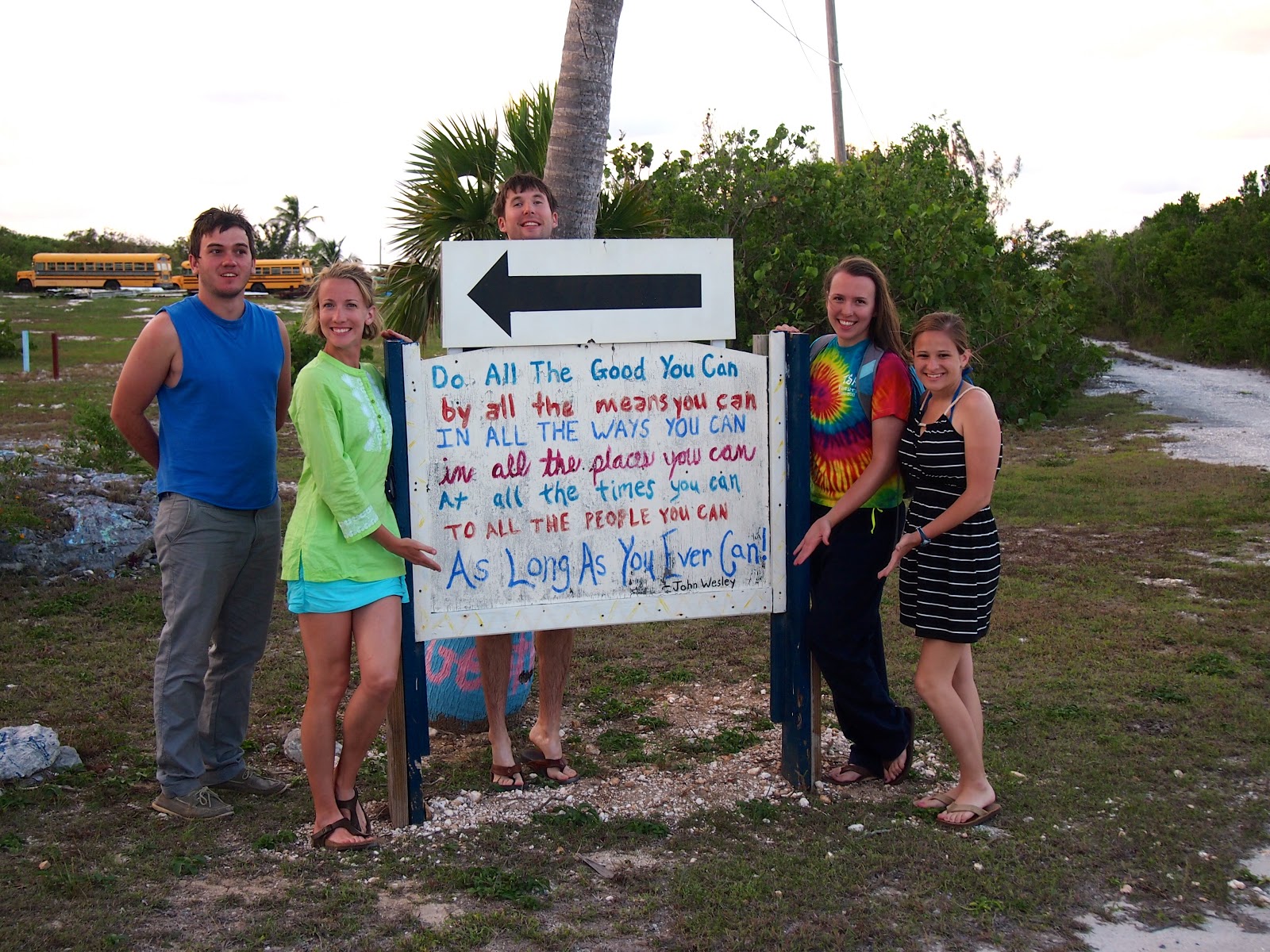
Mission trips are opportunities to be the literal hands, feet and voice of Christ in our world, but such opportunities are presented to us daily. We are always on a mission or in mission for God no matter if we’re on Eleuthera or at home, at work or in the grocery store. God gives us everyday opportunities to be his hands, feet and voice in a world that desires to see God’s presence outside of the church walls. Are you seizing those God-given moments to be Christ to the world? Such a commitment to be Christ in your everyday life could be the foundation of a stronger, more relevant church that not only talks about changing the world, but is in fact changing the world as we know it.

How Do You Want to Be Remembered?

Can I lend you a hand?
How do you want to be remembered or known by people? I've done many funerals since coming to Wesley Memorial. I believe the count is up to 16 lives celebrated. All have truly been celebrations of life, and as family and friends gathered together to tell stories of the deceased they spoke of characteristics, behaviors, hobbies each loved one would always be remembered or known. In my mandatory University 101 class with Dr. Parker at Gardner Webb University, I remember he had us write our obituaries. I wish I still had what I wrote because for the life of me, I can't remember what I wrote in my obituary. Dr. Parker prepped us for this task by asking, "How do you want people to remember you?"

I've been thinking about this a lot as I've been spending what looks like will be one of my favorite member's last couple days with us in this world. Doris is like a grandmother to me, and she will be remembered to me for her abounding love and cheerfulness. She is a person who never meets a stranger, and you can't help but love Doris because she can't help but love people. I know hers is the kind of life that Jesus will welcome into heaven with the words, "Well done, my good and faithful servant." I like to tell people that I have a great job because it is simply my job to love people. Doris' life was about loving people; it wasn't a job, but just how she was--a person defined by loved. She will be remembered forever by her family and friends for her love. How do you want to be remembered?

Yesterday after church as I was sitting with Doris; I got a call, but didn't answer it. As I was leaving the hospital I listened to a voicemail from a man named Joseph who asked me to call back. I called Joseph back, and he said, "Hi Rev. Sipes. I heard you are a person who helps people, and I need help." I've received similar calls from various people in need around Columbia. You give your card to one person, and suddenly your number makes its into the hands of those who need a ride to work, a meal, some gas, a person to talk to, clothes or help with finding a place to stay. I don't mind. I've never thought much about these calls, other than it is my job as a clergy person to help such people in need. I don't think my college obituary said anything about being a person who helps people, but when Joseph called me, I immediately felt honored to be known as a person who helps people.That's how I want to be known and remembered! I can think of many things I wish I would be known for--a great runner, a great preacher, a theologian, a writer, an artist, a fashionista, the list could go on and on of those things I wish I would be known for that have everything to do with my abilities, work and outward appearance and very little to do with something so simple, yet worthy, as being known as a person who helps people. I want people to know me and remember me as a person who helps people--a person who empties myself for people the way Jesus did for people every single day.
Me and Doris


Striving to be a person who helps people in the name of Jesus seems to me like a much better, fulfilling life than striving for the recognition of the world--an empty pursuit that will never bring lasting satisfaction or fulfillment. If I am honest with myself, most of the things I want to be known for have everything to do with me and nothing to do with God and how God desires I live this one life I've been given.  Sure I claim to use my God-given gifts and talents for God, but ultimately I make life about me, me, me, and such a life is exhausting because it is never ending! My prayer is that God will satisfy my heart as I use my life simply to help people in all the ways I can, using my gifts, my talents, my resources for others, so that God may be glorified in the help he leads me to provide for his people everywhere. My prayer is that more people will call saying, "Hi Rev. Sipes, I heard you're a person who helps people, and I need help."

Friday, May 31, 2013

Stop

What does this road sign mean to you?
Stop. Do you ever really stop? As I was hurriedly driving through town trying to get this and that done, trying to use my time with the utmost efficiency so that not a minute went wasted, I noticed that we humans rarely stop. This could be another lesson I've learned while observing my dogs because they are all too good at  stopping from taking time to smell the flowers, pee on a bush, say hello to other furry friends, cuddle in a lap or soak up the sunniest part of the yard, dogs can teach us something about stopping. As my late father-in-law used to say as he chased such rabbit trails that I too am in the habit of doing, "However, I digress." This is not a post about lessons learned from dogs, but simply an observation of the fact that rarely do we US East Coasters stop. We're always on and rarely off. We're people of production who've been taught to judge ourselves and others by how much we do and accomplish. I used to love the advice of my first FCA huddle leader, "Do not fear death, fear a wasted life," but I think such a phrase all too well defines our over zealous on-the-go way of life; it is sadly a truth about who we are and what we value, a lifestyle that keeps us all occupied 24/7/365. Many of us truly fearing deep inside a wasted life that will not be remembered for any accomplishment.
As I was driving through town, I noticed that rarely does anyone completely stop for a stop sign. You know those big, red signs that by law instruct us to completely stop? Some of my athletes I've coached have failed the driver's exam because they did not make a full and complete stop. Most of us pause ever so slightly to make sure no other cars or people are preventing us from hurrying on to whatever task we are currently in hot pursuit. I'm guilty of this--all too guilty in fact. Stop signs are merely suggestions, just the way speed limits are suggestions, right?
I noticed myself and others disobeying the law time and time again all within the span of an hour, none of us thinking anything of it; no one ever really does until someone gets hurt, I think. Such a rush pace of life in the fast lane is exhausting. I was in a clergy peer group discussion in Nashville at GBOD (General Board of Discipleship), and when asked to describe adults today the number one description was "tired." There is no time to stop, to break, to breathe. I remember during my first six months at my first appointment, I was utterly overwhelmed and exhausted. I started going to a pastoral counselor to unload some of the burdens and pressures I had been heaping on myself. I remember telling him after just six months in the "real world," "If these six months are a window into what being an adult is all about, I don't want to be an adult." He said to me, "But life--adult life or any life--doesn't have to be that way. We've made life that way. Perhaps as a leader in the church, you need to teach that there is another way."
Do you ever just stop and praise God
for his beautiful handiwork?
Just as we often ignore the big, red stop signs of our everyday existence as drivers, we, Christians, tend to ignore or at least play down the whole 4th commandment where God commands us to "observe the Sabbath and keep it holy," or in other words stop and honor God of Lord of the Sabbath. Yes, Jesus "worked" on the Sabbath (Mark 2) and in doing so he honored our Father as Lord of the Sabbath, but we cannot deny that Jesus was also very much in the habit of keeping Sabbath by stopping, retreating away to pray, to be alone, to worship, to eat, to commune with his closest friends. This one incident in Mark 2 does not null and void the full picture of Jesus' life and ministry that illustrates much sabbathing, coming to a full stop before God.
Our modern concept of Sabbath being an hour or two on Sunday is merely a rolling stop at a stop sign, and let's be honest, for most of us, the hour or two we church together is more about us than it is about God. Yes, I said it. The music that's not to your taste, the person sitting in your pew, pews being roped off, the preacher's mediocre sermon, the person wearing jeans or bringing coffee into the sanctuary, a fussy baby wouldn't irritate or distract you so much if you were really there for God. "The sabbath was made for humankind, and not humankind for the sabbath; the Son of Man is Lord of the sabbath." Or as contemporary Christian singer and songwriter, Matt Redman, sings, "I'm coming back to the heart of worship/it's all about you/all about you, Jesus/I'm sorry for the thing I've made it/When it's all about you/It's all about you Jesus." Redman's song is about worship, but the same could be said about getting back to the heart of the Sabbath; it's all about Jesus, and yet do we even really stop for Jesus?

Tuesday, May 7, 2013

Another Lesson from a Dog


Wiley
My sister's dog, Wiley, has been living with me and my husband for almost three months. He is just a puppy, and he needs lots of attention. Recently he has started to guard the dog food with a ferocity we have never witnessed in him until now. We put out three bowls in the morning and evening; one bowl for every dog. Wiley likes to eat from all three bowls, and he doesn't like to let Zip or Nova, our two dogs, eat from any of the bowls. He hasn't quite learned to share very well yet, and because of that he has put on a few pounds. At first Hiram (my husband) and I didn't notice Wiley standing guard over the food bowls. I usual put out the food in my morning rush to get ready for work, so I don't sit and watch them eat. And Hiram usually fills the bowls as we are fixing or eating our supper, so again, we don't watch them eat. We noticed Wiley had gained quite a few pounds--more than just the typical puppy filling out, though that is what we attributed his weight gain. But last week when we did watch the dogs eat, Wiley bounced from one bowl to the next, not allowing the other dogs to eat at all even though there was plenty of food to go around. Our dogs do not go without food; they are well fed and loved members of our family. Wiley must know, after 3 months of this same feeding routine, that there will always be food every morning and every evening as sure as the sun rises and falls, and yet still he guards the food as if he doesn't know when and where he will get his next meal.

Jesus said in Matthew 6, "Do not worry about your life, what you will eat, what you will drink, and what you will wear. Is not life more than food, and the body more than clothing? Look at the birds of the air; they neither sow nor reap nor gather into barns, and yet your heavenly Father feeds them." And yet, many of us still hang on to food, clothing, and other material things like we don't have enough when the reality is that many of us living in the US and sitting in pews on Sunday have more than enough. Then why do so many refuse to share, to hoard, to guard what they claim is theirs? "Where your treasure is, there your heart will also be." Many hearts are given to the treasures we hoard for ourselves while many in our own very community don't have access to the basics such as shelter and food. Maybe it's time we all read the parable of the rich young ruler (Matthew 19, Mark 10, Luke 18), and recognize that many of us (Myself included! I'm a product of consumerism!) also would have a hard time letting go of all our possessions, but letting go of all we have and all we are is exactly what Jesus calls his disciples to do when we choose to follow him. Too often we forget that greed--ever so prevalent in our culture--is a sin. So too is gluttony, and who can argue that we are gluttons in more ways than just food gluttons. In another parable Jesus says, "Be on your guard against all kinds of greed; for one's life does not consist in the abundance of possessions." When we stop greedily guarding ours as ours and only ours, then just maybe God will be able to use what we have to help others who do not have. John Wesley said earn all you can and save all you can, so that you can give all you can. The truth is that many of us live lives centered on self, and with a little more attention and intention, we will be able to give much more than we think we can; but yes it may involve sacrifice. If all your basic human needs are met, then you have enough to help make sure others' basic human needs are also met.  So ask yourself: WWJD--what would Jesus do? "Foxes have holes and birds have nests, but the son of man has no where to lay his head." Are you ready to follow Jesus?

Sunday, May 5, 2013

A Lesson from a Mannequin

I have a mannequin in my office. Yes, a three-dimensional representation of a human form that displays clothes. I don't know what I am going to do with it, but when a friend offered a free mannequin I thought it might come in useful one day. But for now she stands in my office in a pretty Banana Republic dress though she lacks a head and both arms. As I was sitting in my office trying to find inspiration for Sunday's sermon, it suddenly occurred to me that too many people who call themselves "Christian" are not too different than my mannequin. Much of my frustration as a minister in our world today comes from people who would rather play church than be church--much the same way kids play house or play school. Too many people equate being Christian with showing up in their Sunday best with smiles on their faces every Sunday morning for worship; but there is more to being church than showing up and dressing the part of a dutiful Christian. John Wesley had a couple names for such Christians: "almost Christians," "honest heathens," "nominal Christians." I can hear the band Casting Crowns singing "If we are the body, why aren't his arms not reaching?/Why aren't his hands healing?/Why aren't his words teaching?/And if we are the body, why aren't his feet going?/Why is his love not showing them there is a way?" Doesn't Jesus tell us in Matthew 28 to "go and make disciples of all nations…" In Matthew's Gospel alone, Jesus says "go" almost 150 times. Jesus lived a life on the go, serving everyone from the most marginalized people of society to Roman centurions, lawyers, tax collectors, and everyone in between. He lived Sunday every day. He came to be God incarnate, and such living couldn't just happen in the temple or synagogue! Jesus set an example for us to be people who go, reach out, speak God's word of love to a world that is in need of hearing, feeling and seeing God's Word embodied. Such a life cannot happen visiting our pews every Sunday, or staying within the comforts of our church facilities. Faithful going means leaving our churches to be God incarnate in our world. A pastor long before I came to Wesley Memorial posted a sign as you leave the church offices, "You are now entering the mission field." To not go and do and serve for and in Jesus' name is to be no more useful to the Kingdom of God than the mannequin who stands in my office who neither walks, speaks or reaches out. In John Wesley's 1741 sermon, "Almost Christian," he accused the church of being asleep," or by my interpretation being no more than mannequins. How, then, are you embodying God's word in all you do and say outside of your church building? Don't settle for merely playing church, be the church! Who knows, such people might just change the world!   

Saturday, March 23, 2013

To Speak or Not to Speak

When conflict arises are you a fight or flight person? Or, when you want to make a point are you a fight or flight person? This morning I read an article in the Wall Street Journal that used different language for the fight-or-flight paradigm. The economist Albert G. Hirschman wrote a book in 1970 called Exit, Voice and Loyalty where Hirschman studied people and organizations' decisions to voice or exit--or in other words to fight or flight. Roger Lowenstein, the author of "The Choice: To Squawk or to Go?", the article in today's WSJ, writes, "Hirschman saw that when organizations make it easy to exit, voice is weakened. Yet, for voice to be effective, a possibility of exit must be present...Exit and voice must coexist in 'seesaw'...Exit is forceful, but it rules out using voice later. However, the reverse isn't true...and Hirschman's third leg of his stool, "loyalty" holds exit at bay." 

Lowenstein points out that "American culture generally have become more fickle." That means the loyalty leg of Hirschman's model is weakened, unstable and perhaps in many ways broken. This also means that exiting is a lot easier, and I would argue that exit is our culture's default at large rather than voice. We've largely become people of flight rather than fight. This is a problem for the United Methodist Church, and many other mainline denominations that are declining and living everyday in the shadow of the inevitable death tsunami predicted by Lovett Weems. We are living in an environment where voice is weakened and because loyalty doesn't hold much weight with people anymore, exit is all too easy. What pastor hasn't made a member upset and the member's threat to the pastor is, "Well, I'll leave the church if you do X." Exiting is not just a present option, but it is the easy default option of many church goers. It is often chosen over voice. Though there are exceptions to the rule, for which I am very thankful.

I've seen this at a pastor of a small church going through transition and change. Environments characterized by a lot of transition and change and rebuilding are ripe for conflict among members who are responsible for working together to build a future. Such a task is not easy, requires a lot of patience, investing time, energy and resources with out any immediate return and people do not agree, so I've seen many people throw their hands up and simply exit because that is easier than voice. But exit does nothing to help, or change, or better the situation of our aging, declining church. The only point "exiting" makes to those of us left behind to carry on is a reminder of the difficult task--sometimes seemingly impossible task--of being, doing, and growing church together.

I've also felt the urge to exit as a young clergy very frustrated with the United Methodist Church. Between the hoops we have to jump through for ordination, the politics of the church, the lack of support and connectionism, the dated structure, the focus on numbers through new initiatives such as vital congregations, the forms, the burden of apportionments that--however good--prevent small churches like mine from having funds to do hands-on outreach ministry in our community because we have very few loyal tithers and $15,000+ is sent to the conference for apportionments, to the daily tasks of "maintaining the aquarium" with little time or support from church loyalist to cast nets on the other side of the boat. The exit option, at times, is very, very tempting.

But exiting is not in our DNA as Methodists, or as Christians. John Wesley--to whom I have more loyalty than to the UMC--chose voice rather than exit; he chose to fight rather than flight, and his life was not easy because of his decision. Even on John Wesley's death bed, his intentions of the Methodist movement was to reform the existing Anglican church. He never wanted a new denomination; he only wanted to reform the current one. He was not always liked. He fought hard battles. He sacrificed a lot in the way of personal happiness and comfort to see the church changed and disciples made. At the end of his life--as hard as it was--I am sure Wesley said choosing to voice, to fight was well worth the impact his life and movement made on a lukewarm church.

As loyal as I am to John Wesley, I am even more loyal to a radical prophet named Jesus who being God could have chosen the easy exit, to have the burden of his cup lifted at any time, but who chose to be loyal to God's will to reconcile humanity through him to the point of death on the cross. Holy Week begins tomorrow with Jesus' "triumphal" entry into Jerusalem which was a loud, defiant voice in the face of the oppressive Roman regime. I learned from Marcus Borg and John Dominic Crossan in The Last Week that as Jesus rode in to Jerusalem on a donkey, on the other side of Jerusalem, Pilate rode in on a horse with 600 hundred foot soldiers. Pilate paraded in that way every Passover season. Jesus could have chosen to exit, to flee, but he chose to "fight," to have a voice when it was very dangerous to do so.

Lowenstein ends his article with a challenge, "So perhaps it is time for some balance, for social structures that listen better and slow the impulse to quit...we should give voice--lest it atrophy--a chance." Churches can learn a lot from Lowenstein and Hirschman. How are we, church, working to listen better and slow our people's--and our own--impulse to take the easy way out? As Christians in the Methodist denomination, we inherit many examples of people who refused to take the easy way out, refused to exit, refused to be silent. We have the opportunity to join our voice to those who have come before whose voices changed the world. So, before you give up on the church, have you tried using your voice to activate much-needed changes? To remain silent is a type of exit. Silence means you may be physically present, but you are mentally, emotionally and spiritually checked-out. Exit, flight, avoidance, silence is easy, is safe, is comfortable. But such a life does nothing for the present state of church and world. Don't waste the voice God has given you; our world--our church--needs people who aren't afraid to risk speaking up.

Monday, March 4, 2013

Lessons From My Dog

Life lessons from an unlikely teacher, my dog, Zip.
I learn a lot from my dog. That may sound ridiculous to non-dog lovers. Dogs and other animals may seem like unlikely teachers; we're the "masters" after all, right? But seriously animals can teach us a lot about life if we take the time to observe them closely. For example, yesterday I preached on Ruth 1:15-22 about Ruth's devotion to Naomi--and thus illustrating God's devotion to us in hopeless times. As I was writing my sermon at 4:30am on Saturday morning (yes, cutting it close to the ever nearing Sunday morning deadline!), Zip, my beloved JRT-chiuaua mix, sat curled in my lap. Every time I took an extended pause or sighed a frustrated prayer for inspiration, she would look up at me with eyes that said, "You can do it!" I had been sick with a stomach bug all week, so I think she intuitively knew I needed some extra love, encouragement and support. She never left my lap until I was finished. There was a night also this week I just slept in the bathroom, and Zip never wandered from my side, choosing to sleep curled up next to me on the hard bathroom floor instead of our comfy bed. There is a reason dogs are called a human's best friend. Loyalty. Devotion. Faithfulness. Companionship. All things the story of Ruth taught us this past Sunday.


My faithful companion; always by my side.
Zip's life and behavior have illumined other biblical lessons for me. For example, when we were reading the story of the Tower of Babel in Genesis 11, I thought about how Zip gets on the tallest piece of furniture she can, so she can be taller than me and Hiram, illustrating her desire to be greater than her masters just like the people building the Tower of Babel. Our dog trainer tells us that we're to make her get down when she tries to assert her dominance in such a way. God had to do the same thing with those humans trying to be greater than their Creator. Or Zip embodies all too well the cycle of obedience and disobedience of God's people wandering in the wilderness. Zip is trainable, but she is stubborn and has a mind of her own; she wants to do things her way. Sound familiar? Slowly she is learning that obedience and discipline--rules--are actually for her own good. Or, it is not in Zip's nature to willingly share; whether toys, bones, bed space or mommy time, Zip is quite selfish and likes to hoard everything for herself. Though she is relatively silent, you can see her say with her eyes and a snarl, "Mine, Mine, Mine!!" Hmmmm...sound familiar again? Zip's nature doesn't sound too far from our own human nature, does it? She is a mix of good and bad, making good decisions, but also making some bad ones. Sometimes--more often than not--teaching me what not to do as much as what to do! I guess we humans, despite our higher cognitive abilities, are really just animals. My dad told me that once when he was giving me the birds and the bees talk. I thought he was ridiculous (not to mention slightly awkward), but having been a dog owner for 3 years now, perhaps dad was right; at the end of the day we are part of the animal kingdom!

Zip is named for Zipporah, Moses wife.
I guess I shouldn't be surprised that she
is full of biblical lessons for me!
These are the kinds of things I think about on long runs when I'm out on the roads in the wee hours of the morning all by myself. I was thinking about this as I returned from my run this morning to find Zip in the only piece of sunshine in our backyard. She often does this--seeks out the one sunny spot in our oak-tree shaded backyard. Another life lesson brought to me by Zip. Often we feel darkness around us--hard times, valleys, pain, suffering, struggles--and we do nothing to move to find that one spot in our life where light is shining in. There's always light shining somewhere; Zip always finds sunshine even if it is off her beaten path. Instead of seeking out sunshine, many times, we wallow in the shade, shivering and shaking in our own misery. We feel stuck in under a rain cloud much like Eeyore from Winnie the Pooh who lives under a perpetual grey cloud. Such a spot can make us blind to the sunny spots in life. We convince ourselves that light cannot break into our darkness. But didn't Jesus tell us that the darkness of this world has been overcome with the Light? Like Zip--in such a simple and intuitive decision--we must see where Light is breaking into the darkness of our life and world, and sometimes that means we must move to that light, not waiting for the sunny spots to come our way by-chance.

My mom used to say to me when I woke up in a bad mood, or came home from school in a bad mood that I can choose not to be in a bad mood; I can choose how to respond to present circumstances. This advice used to annoy me, and only make me hold on to my bad mood longer. But my mom was right--so many of the lessons she taught me as a child have panned out to be true and valuable, and I am thankful, now that I am an adult, for her pearls of wisdom. My mom's advice and Zip's chase for the sunniest spots in our yard teach us the same lesson: we do get to choose how we respond to "dark" days--whatever that may look like for you. God does not want us to be miserable. But we live in a broken world where broken people do broken things, so there will be those down days, or weeks or months, but we must remember that "the Light shines into darkness, and the darkness did not overcome it." Our God is Emmanuel, God with us--yes, with us even in the middle of all the brokenness of our world and our lives. There's always light shining somewhere; sometimes you have to just seek it out.